Your glasses sit beside the part of a haircut most likely to change: the fringe, temples and hair above the ears. It makes sense to consider them together. Yet advice that assigns a single haircut and frame shape to every round or square face can turn a useful comparison into a set of rules you never chose.
A better approach is to start with glasses that fit and function properly, then compare the amount of hair you want around them. You are choosing an overall look and a comfortable daily arrangement, not solving an equation that produces one ideal frame-and-hair combination.
Get the fit question out of the style discussion
Glasses should not need a hairstyle to keep them in place. If the frame slips, presses or feels uncomfortable, have it checked rather than arranging your hair around the problem. Keep your usual prescription and any advice from your eye-care professional separate from suggestions about color, shape or visual balance.
The College of Optometrists’ spectacle-fitting guidance emphasizes appropriate measurements and checking fit, comfort and function. A virtual preview cannot perform those checks. Haircut photographs are useful for style conversations; they do not establish whether a frame is correctly fitted or suitable for your visual needs.
Bring the glasses you wear most often to a haircut consultation. A pair used all day matters more to the decision than sunglasses you wear occasionally. If you alternate between two very different frames, explain that too. You can choose a cut with more than one way to arrange the front.
Decide how much of the frame you want visible
Start with the outline rather than a label. Do you like the full upper rim to show, or do you prefer some hair crossing it? Would you rather keep the temples clear or let longer sections sit beside them? Neither is inherently more flattering. The question is which arrangement feels intentional to you.
A fuller fringe and a prominent upper rim can create a stronger band across the front of the face. Sweeping the fringe away reveals more of the forehead and frame. These are visual choices you can compare in a mirror; they are not diagnoses of a face that needs correcting.
Try the comparison with your ordinary expression and posture. Look from a normal conversational distance as well as close up. A tiny detail that seems important in an enlarged selfie may be almost invisible when someone sees the full haircut, glasses and clothing together.
Check what happens around your ears
Take your glasses on and off in the way you normally do. Notice whether the arms catch a section of hair or push it into an arrangement you do not like. Tell the stylist about that specific interaction. “This section lifts whenever I put my glasses on” is more useful than simply asking for less bulk.
Do not remove all the hair around the ears just because you wear frames. You may prefer coverage, and there may be more than one way to cut or arrange it. Ask what keeping that length would require and whether the side shape can remain workable between appointments.
For longer hair, keep temporary arrangements comfortable. The American Academy of Dermatology’s guidance on pulling hairstyles explains that repeated tension can damage hair. Do not tighten a ponytail or pin a section painfully simply to reveal a frame or imitate a reference photograph.
Use previews to explore, not to certify
Look for two contrasting options rather than searching endlessly for the perfect image. Compare, for example, a fringe that sits near the frame with an arrangement that moves away from it. Keep the change limited so you can tell which part of the look you prefer.
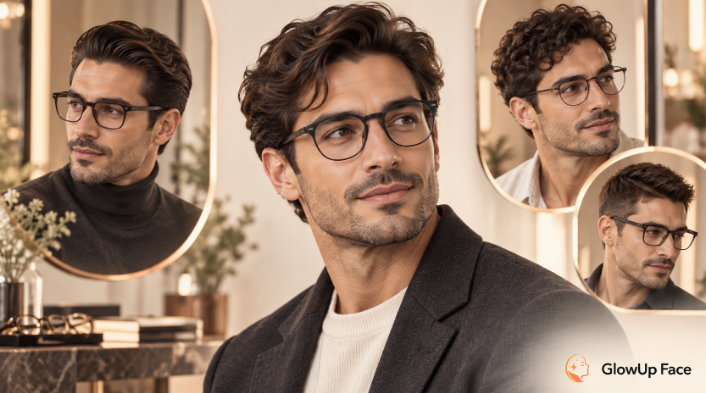
GlowUpFace’s hairstyle finder explains its paid six-panel comparison: a current-style reference and five AI-generated alternatives. It can provide hairstyle ideas, but it is not an eyewear-fitting tool and does not guarantee that glasses or fine hair details will be rendered accurately. Assess your actual frame in a mirror and confirm the haircut with a stylist.
When a generated image removes your glasses, alters their size or changes your face, do not interpret that as a recommendation to replace anything. You can still use the image to describe hair direction or approximate length, while discarding the parts that do not match reality.
Try the combination with clothes you actually wear
Put on one familiar everyday outfit and, if useful, one outfit for a setting that matters to you. You are checking whether the haircut idea fits the way you dress, not whether every collar requires a different hairstyle. Notice which version you would enjoy wearing without elaborate preparation.
Style words can help: relaxed, structured, understated, playful or dramatic. Use them as preferences rather than promises about how other people will judge you. A strong frame and a soft hairstyle may be an appealing contrast; an equally strong haircut may be exactly what you want instead.
Leave the appointment with one usable reference
Before the cut, summarize the request: “I want my usual glasses to stay fully visible, enough side length for coverage, and a front section I can move away from the frame.” Adjust that example to your own priorities. Ask the stylist to show where the intended length will sit.
Afterward, save a normal photograph wearing your glasses and note how you arranged the hair. That gives your next appointment a practical starting point. The best pairing is one you like, can maintain and can wear comfortably—not the one a chart assigns to a shape label.

 Ask Michael Fullerstrat how they got into fashion events and runway highlights and you'll probably get a longer answer than you expected. The short version: Michael started doing it, got genuinely hooked, and at some point realized they had accumulated enough hard-won knowledge that it would be a waste not to share it. So they started writing.
What makes Michael worth reading is that they skips the obvious stuff. Nobody needs another surface-level take on Fashion Events and Runway Highlights, Wardrobe Essentials, Style Tips and Advice. What readers actually want is the nuance — the part that only becomes clear after you've made a few mistakes and figured out why. That's the territory Michael operates in. The writing is direct, occasionally blunt, and always built around what's actually true rather than what sounds good in an article. They has little patience for filler, which means they's pieces tend to be denser with real information than the average post on the same subject.
Michael doesn't write to impress anyone. They writes because they has things to say that they genuinely thinks people should hear. That motivation — basic as it sounds — produces something noticeably different from content written for clicks or word count. Readers pick up on it. The comments on Michael's work tend to reflect that.
Ask Michael Fullerstrat how they got into fashion events and runway highlights and you'll probably get a longer answer than you expected. The short version: Michael started doing it, got genuinely hooked, and at some point realized they had accumulated enough hard-won knowledge that it would be a waste not to share it. So they started writing.
What makes Michael worth reading is that they skips the obvious stuff. Nobody needs another surface-level take on Fashion Events and Runway Highlights, Wardrobe Essentials, Style Tips and Advice. What readers actually want is the nuance — the part that only becomes clear after you've made a few mistakes and figured out why. That's the territory Michael operates in. The writing is direct, occasionally blunt, and always built around what's actually true rather than what sounds good in an article. They has little patience for filler, which means they's pieces tend to be denser with real information than the average post on the same subject.
Michael doesn't write to impress anyone. They writes because they has things to say that they genuinely thinks people should hear. That motivation — basic as it sounds — produces something noticeably different from content written for clicks or word count. Readers pick up on it. The comments on Michael's work tend to reflect that.